
05 / Collaboration Stories

Stories that make the invisible visible.

We choose to keep our clients’ names private, while sharing the lessons their stories make visible.

01
SOFTWARE / SALES / BOARD

When you know exactly what you sell, and your client doesn't.

Slow Cooking / Work design

A software group had spent ten years growing quickly: new countries, new partners, a series of acquisitions. Every one brought better technology, clients and expertise into the building.

It also brought something nobody had designed. Each acquisition arrived with its own culture and its own way of working. The company thought of itself as highly collaborative. It was also, quietly, highly competitive with itself.

“There is no shared vision.”

Sales ran on individual quotas. The largest and most complex clients were covered by several salespeople calling on different divisions, without knowing about each other. Product management and development were turned inward and rarely saw a client at all.

“I have my own quotas to hit. I can't afford to spend time helping other people hit theirs.”

The trust was there. The goodwill was there. What was missing was a system that made collaborating rational, and objectives that were shared rather than divided.

What we found

  1. The board. Fourteen executives who were not aligned, and fourteen organizations underneath reproducing exactly that.
  2. The interface between sales and product. High interdependence, low connection.
  3. The client journey. It was assembled by whichever division got there first.
  4. The incentives. Collaboration was requested and individual results rewarded. Where those disagree, the reward wins.

What the diagnosis gave them

A map of how the company actually worked, next to the one on the chart. The internal connections ranked by what strengthening each one would return. A baseline, so that change could be measured rather than claimed.

Our recommendation was to wait for ongoing leadership changes to settle before aligning objectives and incentives. The diagnosis gave the company a map and a baseline for that next step.

Talent was never the problem. What the company was missing was a way for fourteen people to think like one client.
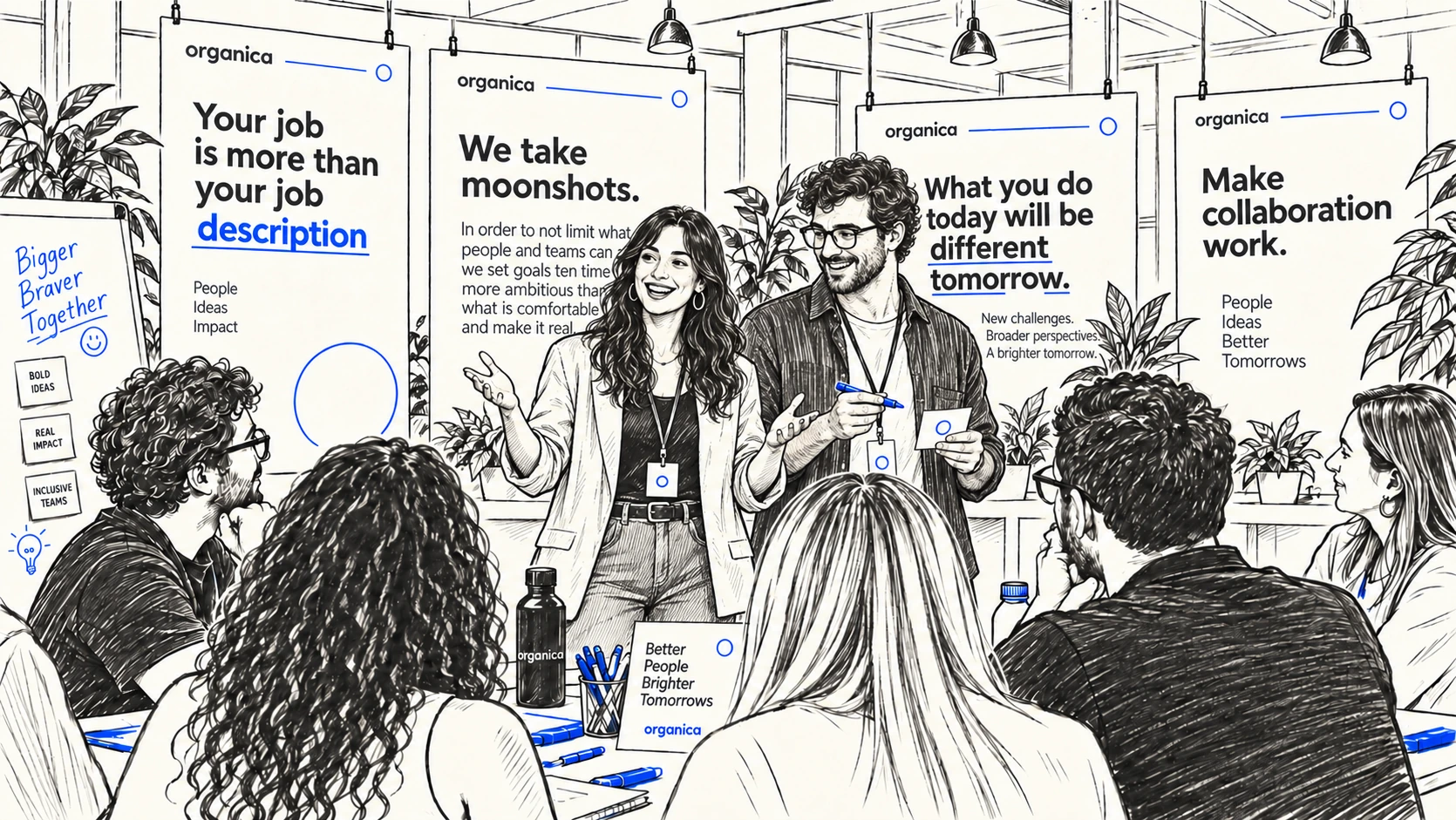
A collaborative workshop in progress
02
PUBLIC SERVICE / SYSTEM DESIGN

When the service is excellent and the client can't tell.

Slow Cooking / Work design

For the people who lived there, there was one organization responsible for the environment. There were two: a public company and a department inside the city council, roughly 1,400 people between them. And the same person led both.

Responsibilities overlapped without anyone owning the overlap. A language built on acronyms meant that people in the same meeting were not always discussing the same thing. Decisions that should have taken days took weeks.

The work itself was good. Much of the time it was excellent. What reached the citizen was not the quality of the work but the shape of the organization delivering it.

What we did

We mapped the real collaboration ecosystem across both organizations and their external stakeholders. Then we analyzed 77 processes, reorganized them into 21 macro-processes, and consolidated them into 5 environmental clusters, delivering around 70% structural simplification.

What changed

Once the environmental value chain was visible, people could locate themselves in it. Each team could see its contribution to the whole, which parts depended on it, and which existing relationships it had never thought to use.

What stood between the capability and the citizen was not effort, budget or commitment. It was design.

03
ENERGY / PLANNING & PERFORMANCE

When the team is tired and you are sure it is the workload.

Slow Cooking / Work design

The Planning & Performance team of a large energy company had come through a long reorganization, and it showed: people were tired. The manager's diagnosis was reasonable. Trust and morale had taken the hit.

But the real friction was at the boundary. Every business unit sent information in a different shape, at a different time and in a different level of detail. The team chased, reworked inputs and stayed late to absorb the difference.

The overload was real. It just was not being generated inside the team.

The ambition that came out of it

Planning & Performance should not be the place where reports are assembled. It should be the integrated intelligence hub of the organization, with transversal collaboration, clear data governance and predictive capability.

What changed

The team came out with a shared reading of its collaborative profiles, named bottlenecks, a shared vision and a roadmap. Its internal network became strong enough that collaboration no longer had to route through the manager.

The intervention made the team more autonomous, cohesive and able to hold its own position in the organization.

04
FAMILY BUSINESS / GOVERNANCE

When you are sure everyone in the room has a voice.

Fast & Fresh / Team sessions

A large family business gathers its shareholders once a year: four generations, around twenty people, from the leaders who built the group to members as young as sixteen.

The format was a set of presentations. Which meant that for most of the day, most of that diversity was not in the room at all.

Diversity of thinking is not a property of who is invited. It is a property of what the meeting lets them do.

A large room where contribution means speaking in front of everyone rewards those who think out loud, at speed, in public. Everyone who processes before speaking, or contributes better in a group of three, is quietly filtered out.

What we did

We redesigned the Family Council around different modes of contributing, direct exchange between generations and work in smaller groups before it reached the full room.

What changed

The Council now has an identity of its own and a repeatable format built for dialogue and co-creation. Younger members participate actively, and the family can see which instincts are worth developing.

Legacy and fresh perspective were both in the room. What was missing was a way for them to meet.

LET’S TALK06

Tell us what you need to solve.

Start a conversation